Mayakovsky in the Cold
A Feb reading/listening/annotation list

In February—the coldest time of year, when time slips fast through the endless nights, when nothing feels possible—I felt a distinct lack of motivation/inspiration to write much at all. I did, however manage to publish a few pieces that I am distinctly proud of. First, this analysis on the current state of birth control attitudes in the US for Vox. Second, this voicey piece of criticism for Defector on what recorded theater is for and should do. Third, my ongoing contributions to Psyche’s series of short personal insights, Notes to Self.
February annotations:
2/1: Mayakovsky in the cold
In case you didn’t know, I have a day job now. Gainful employment is my 2026 experiment, in hopes that removing the urgency of full-time freelance writing will decompress my brain and allow me to pursue more creative (read: worse paid) writing projects.
Entering into corporate life has been a psychological wringer, and I (internally) threaten to quit every fourth day. It doesn’t help that I feel like an interloper or playactor in these spaces. It also doesn’t help that I have started this experiment in the coldest, darkest time of year. And alas the corporate grind is indeed a grind, even if you don’t particularly care about the job or doing well in it. I have paranoid visions of the corporate world bleaching thoughts and inspiration out of my brain.
But throughout all this I’m trying to remember the purpose of this experiment, which is to see if alleviating the pressure to write continuously for money will bring back the wandering eye/mind required to ignite the desire to write for oneself. I’m reminded of the poem Mayakovsky by Frank O’Hara, but especially the ending stanza:
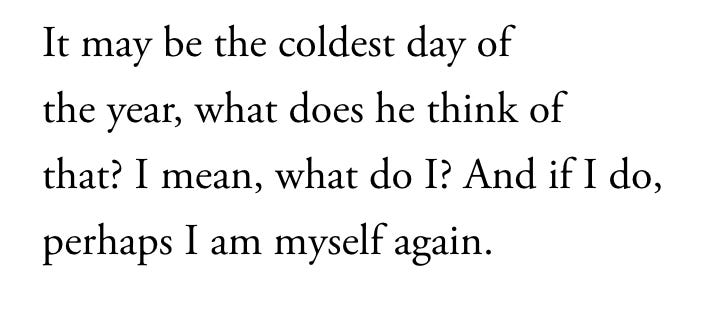
Here's to hoping to be myself again.
2/3: Prove your work
I loved reading this Dan Brooks piece in The Atlantic about how the use of AI degrades relationships by creating asymmetries in the effort to maintain those relationships. A passage I especially liked:
When my brother texts “How’s it going?,” he’s not seeking information so much as connection. That connection is thwarted if I ask ChatGPT to draft a 50-word reply about how his baby is cute and I love him. To prevent hard-core get-it-done types from inflicting slop on the rest of us, we need to agree that my sending you material written by ChatGPT is insulting, the same way you would be insulted if I were to play a recording of myself saying “Oh, that’s interesting” every time you spoke.
Brooks later writes that many of our relationships are defined by mutual obligation. Written messages in these relationships function as “proof of work,” demonstrating effort from the writer to meet those obligations, or displaying commitment to the reader. He goes on:
Generative AI sabotages the proof-of-work function by introducing a category of texts that take more effort to read than they did to write. This dynamic creates an imbalance that’s common to bad etiquette: It asks other people to work harder so one person can work—or think, or care—less.
I mean, if that isn’t the cold hard truth.
2/7: It will pass
During the coldest days I have ever experienced in my time in NYC and a bout of gloom (see 2/1 Mayakovsky), I found the song Cold by Naaz. Though the song is a bit dramatic for my usual music tastes, something about Naaz wailing “it will pass” really hits. Anyway, here’s a playlist inspired by the cold:
2/9: Mad maxxers, sad centrists, Becca Rothfeld at TNY!
I am new to Sam Kriss’s work but I am now a fan! You should all read his Substack essay Century of the Maxxer, which is such a sharp and funny takedown of -maxxer culture.
Also necessary reading: Rayne Fisher-Quann’s essay Centrist Imaginations, on the vacuous logic of Bari Weiss/The Free Press’s politics. RFQ is such a remarkable and thoughtful cultural critic.
The one silver lining I’ve found post-Post layoffs is that my favorite lit crit, Becca Rothfeld, will continue her good work at The New Yorker. The announcement came in bio at the end of Rothfeld’s new piece for the magazine, about what the end of The Washington Post’s book section means for readers, but also what a newspaper’s recommendations are really for. As she puts it:
A newspaper is—or ought to be—the opposite of an algorithm, a bastion of enlightened generalism in an era of hyperspecialization and personalized marketing. It assumes that there is a range of subjects an educated reader ought to know about, whether she knows that she ought to know about them or not…Its mission is not to indulge existing tastes but to challenge them—to create a certain kind of person and, thereby, a certain kind of public.
I don’t want to post more excerpts of the piece, because you really should read the whole thing. But I do want to highlight Rothfeld’s kicker, which really cinches into the true horror of algorithmic book recommendations:
On Amazon, the glorious inconvenience of browsing shelves or combing through piles has been eliminated. There is no occasion to pick up an unfamiliar book out of sheer curiosity. Every book that the site’s algorithm recommends is similar to one that you have purchased already. In this way, you encounter nothing but iterations of yourself forever. It is a world in which the customer is always right. But if you didn’t want to be proved wrong, if you didn’t want to be altered or antagonized in ways that you could never predict, why would you read at all?
2/12: Shuddering Heights
I watched Wuthering Heights with Eleanor and the only thing I want to say about it is that Emerald Fennel has capital “v” Vision, but maybe no Sense.
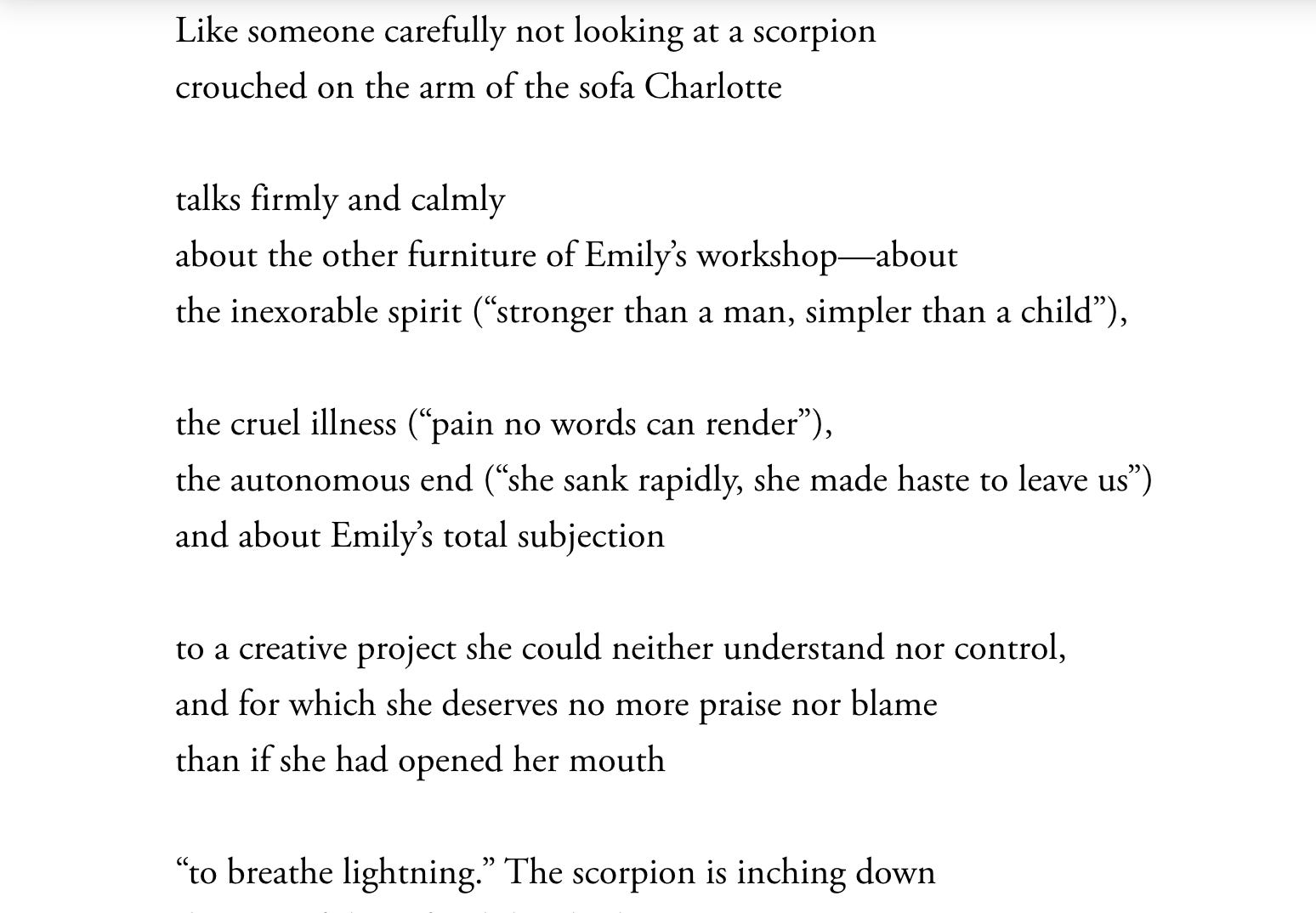
The movie instead made me think of the only good tribute to Wuthering Heights/Emily Brontë, The Glass Essay Anne Carson, which is awfully long but incredibly worthwhile.
2/17: The End of Thinking
After I discovered Sam Kriss’s work, I started seeing him everywhere (Baader-Meinhof), including in this Harper’s piece, Child’s Play. And holy smokes, what a magnificent piece of reporting. It’s about a lot of things—AI, isolation, circular thinking, “agency,” masculinity—but it’s an especially good dissection of some of the strange personalities in the world of Gen Z tech entrepreneurship. Outlandish quotes from sources include:
“Women love Labubus, so we have Labubus.”
“I knew since the moment I gained consciousness that I would go start a company one day,”
“…people are smart enough that they could answer their own questions, but they want someone else to do it, because then they don’t have to have this terrifying encounter with their own humanity.”
“…it is a sperm race—it’s just up-skinned.”
“They have too much money and nothing going on. They have no swag, no smoke, no motion, no hoes. That’s all you need to know.”
“We’re all feminists here…We’re usually up at four in the morning. We’re debating the struggles of women in today’s society.”
“I would be happy dying at any age past twenty-five. After that it doesn’t matter, bro. If I live, I have extreme confidence in my ability to make three million dollars a year every year until I die.”
“I do not obtain value from reading books…I don’t care about the Decanterbury Tales.”
2/19: petal rock black
I’ve said it once, I’ve said it forever: WILLOW is my favorite nepo baby.
This is an Artist who has used her resources and networks to experiment and play with her craft to develop a fully-formed musical persona. The album feels raw yet meticulous, and is at once self-serious yet playful.
2/20 So Yesterday
Let the record show that I am no Hilary Duff hater. I adored Lizzie McGuire, and Metamorphosis was the second CD I ever bought with my own money (the first was Avril Lavigne’s Let Go). So when she announced her return to music, I was excited to see what 2026 Hilary Duff, adult pop star Hilary Duff, would sound like.
Unfortunately, the new album, “luck…or something” is not a comeback. The album title is the first clue to the fact that this project, and Duff as a pop star herself, has absolutely no point of view (besides the fact that she is not a child but a horny adult who has sex). The writing is surprisingly graphic but in a corny and jarring way that carries neither the playfulness of someone like Sabrina Carpenter nor the sultriness of, I don’t know, almost any other pop star. And the music is a touch too referential for my liking. The lead single “Roommates” is clearly knockoff Carly Rae Jepsen (Duff’s husband used to date/write for CRJ) and one of the better tracks, “We Don’t Talk” is basically “Somebody That I Used to Know.” If you like this stuff, no you don’t, you’re just nostalgic for flip phones.
2/24: Uncivilized shrieks
I just finished Anne Carson’s monograph, The Gender of Sound, a copy of which Eleanor gifted to me for my birthday a while back. A classicist by training, Carson discusses the deviant sounds from the fairer sex who, according to the Ancient Greeks, have a “‘natural’ female affinity for all that is raw, formless and in need of the civilising hand of man.”
It’s a fascinating read—I hadn’t before realized how preoccupied the Ancient Greeks were with the supposed virtues of a silent woman. Silence being a sign of resistance against the female’s instinct to shriek and make public the thoughts and feelings that should remain hidden from the public sphere. Ancient wisdom supposedly said that “man can know from the sound of woman’s voice private data like whether or not she is menstruating, whether or not she has had sexual experience.” So shut up and keep your lack of chastity to yourself.
In fact, “it is an axiom of Ancient Greek and Roman medical theory…that a woman has two mouths,” an upper and a lower. An open mouth may lead to “unspeakable things.”
2/26: What’s a godless man to believe in?
I don’t currently have capacity in my life right now for a crisis of unbelief. But perhaps in a few months I’ll revisit this piece from The New Yorker that asks, what should atheists believe in? I can never return to belief in god, but I have been wondering how lifelong atheists teach and learn moral/ethical structure. After all, day-to-day life requires faith—in others, in institutions, in virtue—whether you’re godless or not.
2/28: Musical fixations
^Ordered from “day music” to “night music,” with an energy peak just past the middle.
Lastly, this month I am also thinking of the second anniversary of both Israel’s killing of Hind Rajab, which passed on January 29th, and the self-immolation of Aaron Bushnell, which passed on February 25th. Rest in peace.